Why Storage Size Can Matter When Identifying a Smartphone
When someone asks what phone you have, the answer is usually simple.
"iPhone 16 Pro."
"Samsung Galaxy S25 Ultra."
"Google Pixel 10 Pro."
For everyday conversation, that's perfectly enough. But when you need to identify a smartphone precisely, the model name tells only part of the story.
A detail as simple as storage capacity can help distinguish between different versions of what appears to be exactly the same device.
One model can actually mean several different products
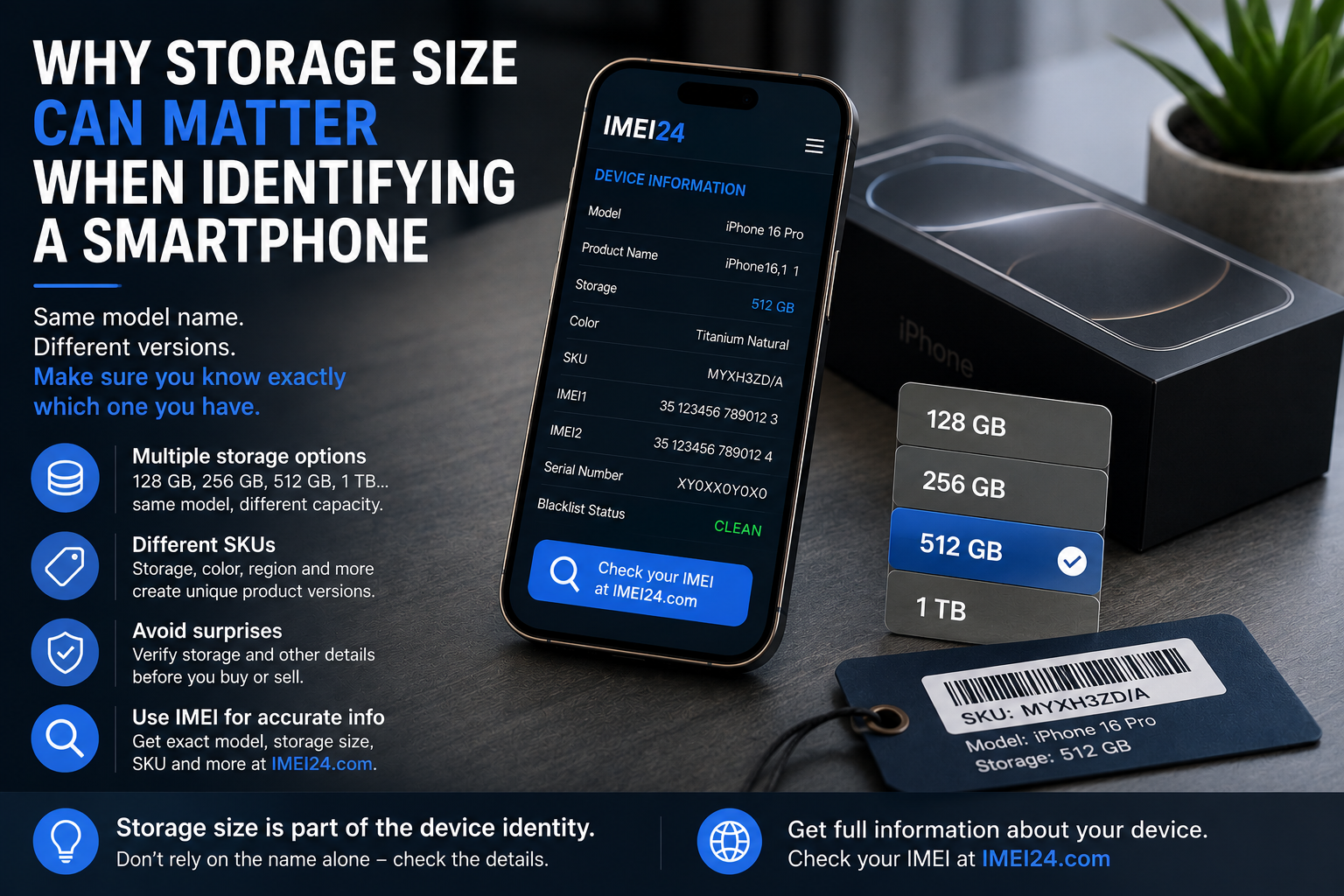
Modern smartphones are usually offered with multiple storage options.
Depending on the manufacturer and model, you may find versions such as:
• 128 GB
• 256 GB
• 512 GB
• 1 TB
They may share the same screen, processor, cameras and external design, but they are still different product configurations.
This becomes important when identifying a phone for resale, service or verification.
Why can't you simply check the storage in Settings?
In many situations, you can - and that is usually the easiest solution.
But there are cases where additional verification can be useful.
Imagine buying a used phone advertised as a 512 GB model. The device has been factory reset and you want to confirm exactly which version you are looking at before completing the purchase.
Or perhaps you are identifying a device remotely and only have its basic information.
This is where product information associated with a device can become useful.
Model name and product name are not always the same thing
This distinction is easy to miss.
A commercial model name is designed to be simple and recognizable.
For example:
iPhone Pro Max
A product description or SKU can be much more specific and may distinguish between storage capacities, markets or other configurations.
In other words:
Model name tells you what family the phone belongs to.
Product information can help tell you exactly which version it is.
What is a device SKU?
SKU stands for Stock Keeping Unit.
Manufacturers, distributors and retailers use product identifiers to distinguish between different configurations of devices.
Two smartphones with the same marketing name may have different product identifiers because one has 256 GB of storage while another has 512 GB.
Other differences may also be reflected in product information, depending on the manufacturer.
These can include:
• storage capacity
• color
• regional version
• hardware configuration
• sales market
This is why SKU and detailed product information can be useful when the model name alone is too broad.
Why storage verification matters when buying used phones
Storage capacity can have a significant effect on the value of a smartphone.
A 512 GB version can cost considerably more than the same phone with 128 GB or 256 GB.
That difference also remains important on the second-hand market.
If you are paying extra for a higher-capacity version, it makes sense to confirm what you are actually buying.
It can also matter when selling a phone
The same principle works in the opposite direction.
When selling a smartphone, providing precise information makes the listing more useful and credible.
Instead of simply writing:
"iPhone Pro - good condition"
a seller can provide the exact model, storage capacity and other relevant device information.
That gives potential buyers a much clearer picture of what is being offered.
IMEI can help identify the exact device
An IMEI lookup can provide additional information associated with a smartphone.
Using IMEI24, available results may include information such as:
• brand
• exact model
• product name
• storage capacity
• device SKU
• IMEI1 and IMEI2
• blacklist status
• other available device details
The exact information available depends on the device and available databases, but these additional fields can make identification much more precise than relying on the commercial name alone.
A practical example
Imagine two phones sitting next to each other.
Both have the same design.
Both belong to the same smartphone family.
Both even have the same color.
But one has 256 GB of storage and the other has 512 GB.
From the outside, there may be no obvious way to tell them apart.
Yet their market value is different.
Their product configuration is different.
And when buying or selling one of them, that difference matters.
Storage is only one part of the device identity
Of course, storage capacity alone does not fully identify a smartphone.
A complete picture may involve several pieces of information:
• model number
• product name
• SKU
• storage
• region
• IMEI
Together, these details help distinguish between devices that may otherwise appear identical.
Why this is becoming more important
Smartphone lineups are getting increasingly complicated.
One model can exist in several storage capacities, colors, regional versions and network configurations.
At the same time, millions of smartphones are resold, refurbished and imported between countries every year.
The more versions manufacturers produce, the more useful precise device identification becomes.
Final thoughts
Storage capacity may seem like nothing more than a specification telling you how many photos and apps you can keep on your phone.
But it is also part of the device's exact configuration.
When buying, selling or identifying a smartphone, knowing whether you are dealing with a 128 GB, 256 GB, 512 GB or 1 TB version can make a real difference.
The name on the box gives you the smartphone family.
Detailed product information tells you which one you actually have.
And when you need to look deeper, an IMEI check on IMEI24 can help reveal the available information behind the device.